


Why Colours on Screen Never Match Print Exactly — and What Smart Clients Do About It
One of the biggest surprises in printing is colour. What looks perfect on your computer screen almost always looks different on paper. That isn’t a mistake — it’s simply how printing works. It helps to be upfront about this reality, so you know what to expect and can make the best decisions for your project.
1. Why Colours Look Different
Screens use light (RGB), while printers use ink (CMYK).
Screens create colour by mixing red, green, and blue light directly into your eyes, which makes tones look bright and glowing. Print works by layering cyan, magenta, yellow, and black inks on paper, which absorb and reflect light. Because one system shines and the other reflects, colours can never look exactly the same.
Even two offset or digital presses running the same file can show slight differences. Room lighting affects perception — the same image can appear different under warm light, daylight, or at different angles. And finally, no two sets of eyes see colour identically. As the old saying goes: “to each their own taste and colour.”
2. The Myth of a “Perfect Match”
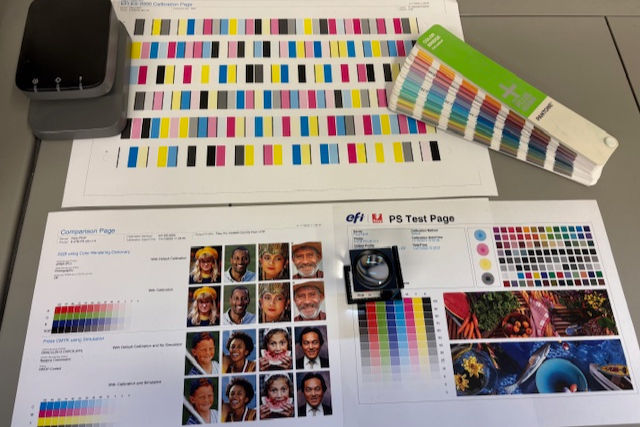
Some people talk about Pantone or “screen-to-print matching,” but in practice, no commercial printer can guarantee your file will look exactly like your monitor. Pantone calibration is a helpful guide, but not a guarantee.
Any printer who promises a flawless screen-to-paper match is selling magic, not reality.
3. Why Printers Doing the Same Job Can Still Differ
Even when two printers use the same file and process, results can vary. That’s because printing is influenced by many factors:
- Humidity and climate: Winter dryness and summer heat both shift results.
- Paper stock condition: Supply inconsistencies (especially since COVID) mean each batch may behave differently.
- Toner and ink: Age, formulation, and storage all affect sharpness and colour.
- Press condition: Calibration, wear, and maintenance have an impact.
- Human factor: Setup, alignment, and operator attention always play a role.
4. The Professional Way to Handle Colour
Experienced schools, nonprofits, and businesses know this:
- They start with a small order or sample proof.
- They review the actual printed piece.
- If satisfied, they move forward with a larger run.
- Over time, they build trust with one printer whose “character” they understand.
Our suggestion is to always begin with a proof or a short run before committing. It’s a simple step that helps you feel confident in the outcome. The decision, of course, is always yours.
5. A Balanced Approach
Good printing partners value honesty, consistency, and fair practices. Choosing one you can trust is the best way to avoid surprises. Every print job has its variables — but with the right preparation, you can manage them effectively.
Conclusion
Colour is never an exact science in printing. But by knowing the process and making thoughtful choices, you can control the variables and avoid disappointment. The more you understand about how colour works in print, the better your results will be — and the smoother your experience.

Comments